iPhone · iPad

Fantom Setlist Editor

Build and rearrange Scene Chain setlists from your Roland Fantom 0 backup, then export a new folder for USB Restore — without rewriting scene tones.

One backup. Silent draft. New export.

The editor is the app — no multi-backup home screen. You work against one active Fantom backup plus a quiet XML-only draft. Scene names always come from the original FANTOM.SVD.

Choose backup

Pick a Fantom backup from Files / USB, or tap Open demo to try sample songs first. On iPhone a real backup is copied in so you can unplug the stick.

Edit setlists

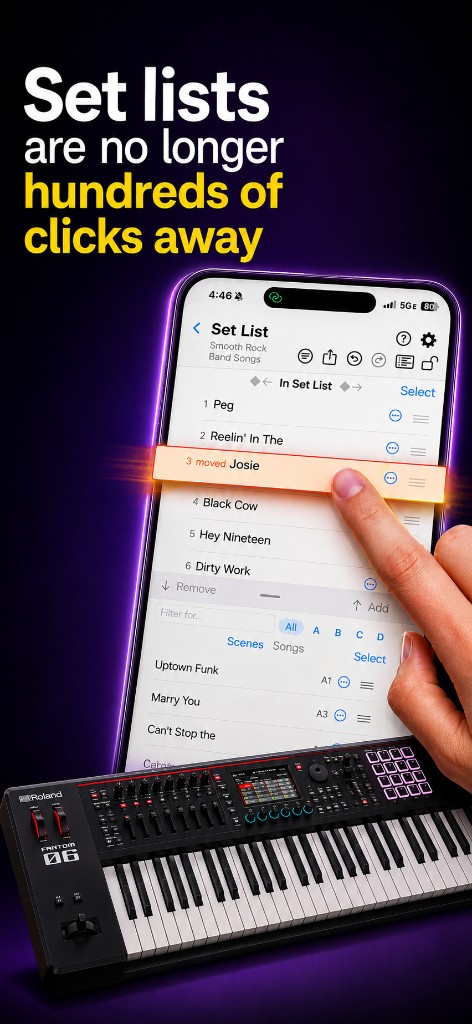
Reorder scenes, markers, sets, and cues. Edits write as you go — there is no Save. Amber / Edited means a setlist differs from the original backup.

Export to USB

Copy the backup + your draft XMLs into a new folder. Never overwrites the source.


Songs ABC vs light cues

Show setlists are tonight’s order. Songs / ABC pools are your repertoire book. Cues pools (e.g. Lights CUES) mark utility scenes — lights, FX, breaks — so they are not counted or shared as songs.

Put the Settings Song List Identifier in a setlist name (default SONGS, or e.g. ABC) to make a catalog the app matches against when you Import from text…. Put the Cues Identifier (default CUES) on a pool like Lights CUES; any of those scenes that also appear in a show setlist count as 💡 cues, drop out of “songs only” Share, and can form Pre/Break/Post blocks in Automated Set Detection.

Setlist list with Details showing song, cue, and set counts
Show setlists with Details — ♫ songs · 💡 cues · 🎬 sets.
Setlist list scrolled to Lights $CUES in slot 18
Cue pool: 18 · Lights CUES — catalog of light/utility scenes, not a musical set order.
Setlist with LIGHT cues marked by lightbulb icons and set color rail
Same light scenes inside a show setlist — marked as cues between sets.
Settings Codes in Setlist Names
Settings → Song Lists and Cues Detection — Song List Identifier (SONGS / ABC) and Cues Identifier (CUES).

What you can do (iOS)

Each feature: what it is for, then the related screens. Labels match the iPhone / iPad app.

Quick start — first open on device

Have a Fantom backup folder on USB or in Files (FANTOM.SVD + SCENE_CHAIN/), or tap Open demo to try sample songs first (Export stays off). After the splash, the app lands on Set Lists. Tap Open demo, or Menu → Import from Folder… / Import from Fantom USB Stick…. Tap a named backup, then Import and confirm PARENT/NAME (path only). Wait for Importing…, then you can unplug. Tap a setlist to edit; later Menu → Export to Fantom USB Stick… or Export to Folder… writes a new folder for Restore.

Move around the app (bottom tabs)

Use the five bottom tabs for the main jobs:

TabUse this to…
Set ListsBrowse and edit Scene Chain set lists (list + editor stay in this tab)
SongsManage learned title → scene mappings (used by New Setlist… → Create from → Text…)
ScenesBrowse all 512 scenes; add one to a set list (confirms)
BandsDefine Band + Name contains filters for the Set Lists list
MenuImport / Export / View original / Help…; Settings via the gear on the Menu header

Multi-scene Songs

On the Songs tab, a song can map to one or more Fantom scenes in a fixed order. When you add that song to a set list (Add, or drag from the editor Songs library), those scenes are inserted as ordinary set-list rows. The Fantom Scene Chain cannot store the musician-facing song title — after Restore you only see each scene’s own name. Optional markers when inserting multi-scene songs are under Settings → Multi-scene Song Markers (Enable automated insert of markers, Inserted markers will be, Squeeze in markers). Import from text… can resolve a line to a Song or a Scene; Create expands songs into their scene lists.

Backup folders & Fantom backup types

On the keyboard, MENU → UTILITY → BACKUP writes a named folder to USB (see Roland FANTOM-06/07/08 Owner’s Manual — Backing up User Data (Backup/Restore), ~p. 34). Check or clear INCLUDE PAD SAMPLE / INCLUDE KBD SAMPLE for a full vs small backup. This app edits SCENE_CHAIN/ inside that folder; Export builds a new folder for RESTORE.

Leave enough free space on the phone, the USB stick, and any Export folder for one or more complete copies of that backup (staging + a new Export folder, plus headroom). Setlists are small; size is mostly samples. Without pad/keyboard samples, expect roughly tens of MB per copy. With samples included, size tracks your libraries — Roland’s Fantom 0 ceilings are about 256 MB for keyboard / multisample (shared with expansions) and about 2 GB for pad samples (including imported WAV/AIFF). Plan on 2–3× your largest backup folder free when Restore must keep samples; a few hundred MB free is usually enough for several set-list-only (no-sample) copies. Stick must be Fantom-formatted (UTILITY → USB MEMORY FORMAT, ≤32 GB).

Open a Fantom backup

Use this the first time, or when you want a different backup. After the splash, the app lands on the Set Lists tab. Until a backup is chosen, set lists stay locked except Open demo on the empty list. Import, Export, and View original… live on the Menu tab (Import from Folder…, Import from Fantom USB Stick…, and Available backups on USB Stick / Available backups in Folder when listed). The app never auto-opens a stick backup. Demo is sample songs only — Export and View original stay off, and demo edits are not kept when you later import a real backup (the demo band/project goes away too). Import from Folder… lists named backups; tap one, then Import and confirm PARENT/NAME (the Restore note is on ?, not on that confirm). On iPhone the app stages a full copy so you can unplug USB. The Songs tab also stays empty with no backup open (for example after installing a new build for testing): learned title→scene mappings need an open FANTOM.SVD to verify scene names. After you import, resolve any Song mappings don’t match prompt if this SVD’s scene names differ from a previous backup version — only then does the Songs list appear with verified names.

Work from the Set Lists tab

This is home for tonight’s running orders. The header shows Set Lists with the backup name underneath. Tap + for New Setlist…. Undo / Redo icons and Details sit on the right. Open the filter strip for Filter for…, Empty, Edited, and (when you have bands) an All Bands picker. Tap a setlist to open it; ← Set List returns here (bottom tabs stay visible). Use Menu for everything that applies to this whole backup — export, compare to original, switch backup, and help. Settings open from the gear on the Menu header (not a separate bottom tab). Sheets close with Cancel, Back, or Close — not by dragging down.

See more about each setlist (Details)

Use Details when titles alone are not enough. Off = names only. On = project line plus ♫ songs · 💡 cues · 🎬 sets. (Inside an open setlist, Details means bank/patch brackets instead.)

Show only one band

Use the Bands filter on Set Lists when you play in more than one band and only want that band’s set lists on screen. First define bands on the Bands tab (a name plus Name contains strings, e.g. Yacht Rock → yar, yacht). Then open the Set Lists filter strip and pick All Bands or a band name.

Find, select, and reorder setlists

Use Filter for… for name or slot. Empty shows empty slots. Edited keeps only what you touched this session. Select for multi actions. Drag to reorder (clear text/Empty/Edited filters first).

Create, rename, copy, swap, clear, delete

Use the setlist row (or long-press). The top line is the setlist name (not an action). Each action opens its own sheet or confirm.

Edit the songs in a setlist

Open a setlist to order the night. Drag to reorder. Drag the transfer handle to show the scene library — portrait stacks ↑/↓; landscape is side-by-side ←/→. On Scenes, use Filter for… plus bank toggles A · B · C · D or All (four Fantom banks of 128; at least one bank stays selected). Songs has its own Filter for… / Details. Drag a scene’s onto Songs to add (or a song’s onto Scenes to remove).

Song actions — Info, clipboard, swaps, markers

Use song for Cut/Copy/Paste, Info… (BPM, layers, memo, setlists), Swap Scene / Marked Block / Sets, Select by Number, and markers. Swipe is Remove only. On iPhone, scroll the menu — not every action fits on screen at once.

Share a setlist

Use Share… to send a text preview via the system share sheet. Share only song names (default on) leaves cues out.

Share
Share setlist…

Build a setlist from a text list

Use New Setlist… → Create from → Text… when you have a pasted list or a .txt / .csv. Or open the same sheet from the Home Screen (long-press → New Set List from Text) or the Shortcuts action of the same name — including lists produced by Apple Intelligence Shortcuts. Match, review, then create (still in the app; first empty set list slot by default). Titles you correct (for example Escape → Pina Colada) are remembered on this device and tried first next time — manage them on the Songs tab.

Undo…

Use Undo… to reverse changes made over multiple steps in this session — not only the last tap. Open from the Undo icon on the Set Lists header, or editor ⋯ → Undo…. Newest at the top; Undo to here jumps back; Undo all clears the stack (Redo still available until you edit again).

Export for Restore

Use Export to Fantom USB Stick… when the stick is plugged in, or Export to Folder… for On My iPhone / iCloud. Both write a new folder only — never your source backup. Put it in ROLAND/FANTOM/BACKUP on the stick (the Fantom only lists folders there). Export to Folder confirm (and ?) notes that System → Restore only sees /Roland/Fantom/Backup/ on a USB stick. On iPhone, Export shows progress (file · bytes) with Cancel. Then Fantom UTILITY → RESTORE → power cycle.

Settings

Use Settings to set folders, Songs/Cues codes, automated set detection, share defaults, and bands once — then every session follows those choices. Open Settings from the gear on the Menu header. About includes Help pages, which opens this manual in Safari. Menu → Help… does the same.


Safety & Restore

Demo sample for screenshots: Mac path …/FANTOM/BACKUP/MyBackup/ includes slot 18 · Lights CUES (LIGHT OFF / WHITE / START SET / RED BREAK + FX/Pad menus). Re-open sample / re-seed Simulator after updating that folder.